Marine and human life under threat by sargassum invasion!

JEK

Senior Insider
https://www.facebook.com/1519309702...8YAo35rcmcMRSwDZwl/?mibextid=bVmsRV&fs=e&s=cl
9D5C15E1-B697-4D77-A129-E40B505ADC2E.jpeg

A9F132AC-8A9F-40E0-BEE0-A407A6041579.jpeg

ECC7A0BF-F494-4354-B7A7-6FBA02400380.jpeg


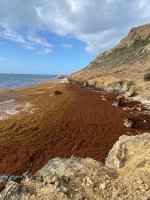
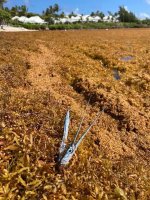
Last night some important buckwheat tables affected different parts of the island!
This has resulted in some places like the Grand Fond being negatively effected by asphyxia on all marine life species that lived on this reef!


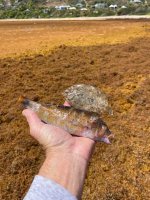
-On the Grand Fond some species of larger sizes for some are still alive like murmurs and have been able to be released more widely!


-On Petit Col de Sac hundreds of Bourgos were also saved there


- In the lagoon of Grand Cul de Sac, it is the juvenile lambs but the thickness of the sargasm prevents us from moving properly. The on-site technical service dispatched a device to the site!
We'll go back late afternoon to follow the evolution.


We strongly advise hikers in the next few days not to go to the natural pools of Grand Fond because the gases that will be emitted by the decomposition of sargassy algae are highly toxic (hydrogen sulfurated and ammonia). Their inhalation and exposure, even at low concentration, has many health effects.
 
From Didier Laplace

hello to all,


Don't put your life on the line unnecessarily if you see cash caught in sargases!


Following the announcement we made with the Reserve to call for volunteers in the Grand Cul de Sac Lagoon, many of you have returned to us.
Just wanted to give an update on possible actions to take in case of more Sargassas coming in the next few weeks or years!


Marine animal rescue must be done only on the first and second day when sargassas fail because after the chances of finding them still alive are very low. In addition, the arrival of sargasses coincide with the nesting of seagulls and they are therefore already present on these boats like frigates approaching our coast to feed on the pelagic fish that are there! So they will continue their feast on the reef fish!
So we are focusing more on saving sea turtles that get caught near the reef (June 2019 image) and doing it on the first day see the next day if the arrival happened at night.


After 24-48 hours, not only are the chances of finding marine animals still alive very low, but the sargasses decompose and release toxic gases (hydrogen sulfur and ammonia). Their inhalation and exposure, even at low concentration, has many harmful effects on health.


In addition, after an arrival I do not advise people to walk on piled sargasses, for example on the shores of Grand Fond and Toiny, as they can reach several meters high as observed in previous years sometimes going up to 5m and then be dangerous if you fall or does it sink in!!


So through experience over many years, I have found that:


-Never intervene alone !


-Wear a full bodysuit or that covers your legs!


- Have a perfect knowledge of reefs or cavities in these places that could be under your feet!


-Presence of empty pockets forming under these sargasm tables!


- When sargasses are compacted by the action of the wave in certain places, if you sink these moving sargasses can break your limb!


- Juvenile lion fish found in these tablecloths even dead their sting is painful!
The venom is contained in the glands associated with the spines and it contains toxins that can cause cardiovascular, neuromuscular and cytotoxic effects for the most vulnerable. This venom is thermolabile, if you get stung by their venom apply a heat source to where you feel the pain and it will destroy the toxins!


- If you don't know the reefs in the impact areas, focus more on the sand areas where you have your feet and you won't risk your life, like the lagoon of Cul de Sac!


- Alert the Nature Reserve when you see huge buckthorn approaching only if you are certain it will end up on our shores will allow volunteers to alert for possible intervention!


- After the second day of the failing of the sargasses, there is nothing left to save so avoid going there because the gases that will be emitted by the decomposition of the sargasm algae are highly toxic.


-Don't put your life at risk unnecessarily!
 
Le Rivage has closed until Tuesday due to the Sargassum. The staff are helping clean up GCdS.
 
We were supposed to have lunch at Sereno tomorrow and were informed by the manager that we should cancel due to the Sargassum. This is getting to be a real problem The powers that be are going to have to find some kind of a solution.

Phil
 
A regular natural occurrence. They just might need bigger machines for cleanups and disposal before it becomes a health hazard. Don’t know how you could cut it off at the source…that’s Mother Nature doing her stuff that annoys the hell out of us.

Meanwhile, the Sahara Sands took a wee break yesterday and I saw the neighboring islands for some afternoon viewing. View is Gone again today.
 
I'm not sure it can be controlled at the source, but I understand there are several groups working on removal and turning it into something useful. The Island may have to invest in some heavy equipment to move it off the beaches faster and more efficiently. When it starts having a bigger economic impact, as in beach restos, and eventually perhaps hotels and villas having to close because of safety concerns, that should get both government and the tourist industry's attention.

Phil
 
I'm not sure it can be controlled at the source, but I understand there are several groups working on removal and turning it into something useful. The Island may have to invest in some heavy equipment to move it off the beaches faster and more efficiently. When it starts having a bigger economic impact, as in beach restos, and eventually perhaps hotels and villas having to close because of safety concerns, that should get both government and the tourist industry's attention.

Phil
I posted in Mexico, Central America,+ South America about a company called Reforest the Tropics. This starts from clear cutting forests and replanting with crops that require fertilizers which enter the oceans and feed the sargassum. People need to eat, however this is what causes the out of control blooms. CEC is the only one who responded. Nothing will change, except possibly getting worse until the fertilizer use is decreased or kept from entering the ocean.
 
I posted in Mexico, Central America,+ South America about a company called Reforest the Tropics. This starts from clear cutting forests and replanting with crops that require fertilizers which enter the oceans and feed the sargassum. People need to eat, however this is what causes the out of control blooms. CEC is the only one who responded. Nothing will change, except possibly getting worse until the fertilizer use is decreased or kept from entering the ocean.

Reforest The Tropics is a much needed initiative...would be nice to see that become a world-wide effort!
 
I posted in Mexico, Central America,+ South America about a company called Reforest the Tropics. This starts from clear cutting forests and replanting with crops that require fertilizers which enter the oceans and feed the sargassum. People need to eat, however this is what causes the out of control blooms. CEC is the only one who responded. Nothing will change, except possibly getting worse until the fertilizer use is decreased or kept from entering the ocean.

Amy. What about Amy?
 
Reforest The Tropics is a much needed initiative...would be nice to see that become a world-wide effort!

It is a noble effort and runoff laden with fertilizer is a contributing factor for sure. A Google search shows two others one expected and one unexpected.


[h=2]Warmer, overnutrified waters[/h]Data gathered over the past decade has revealed the likely causes of these seaweed invasions: Saharan dust clouds, warming temperatures and the growing human nitrogen footprint.
Just as nutrients feed red tide blooms, they feed sargassum, which thrives in warmer water. Climate change also increases upwelling of nutrients from deep ocean waters at the other end of the sargassum belt in West Africa.
The influxes of the past decade seem to have originated along Brazil’s Atlantic coast, not in the Sargasso Sea. Large amounts of fertilizer flow into the Amazon River and then to the ocean from industrial-scale agriculture and ranches. Nutrients also pour into the Gulf of Mexico from the Mississippi River. Climate change-driven downpours increase runoff.
Saharan dust clouds that extend for thousands of miles across the Atlantic Ocean have also contributed to this explosion of sargassum seaweed. The dust contains iron, nitrogen and phosphorus that fertilizes plankton and seaweed blooms. These thick atmospheric dust plumes corresponded with a sargassum spike in 2015 and the worst incursion of sargassum in 2018.
Researchers are also exploring changing in ocean currents, which may be another contributing factor.
https://news.fiu.edu/2021/whats-dri...eed-piling-up-on-florida-and-caribbeanbeaches
 
Just to jump in, we are on the island and have watched the masses of sargasso arrive this week. We are very familiar with the sargasso issue, and have watched the influx grow larger and larger each year. We just sold our home on the Mexican caribbean, which also hosts the second longest barrier reef. We sold due to the increasing sargasso situation. The gases produced by the sargasso turned all the copper and brass fittings in our home black, no matter what we tried, we could not return the items to their original state. It also has caused many electrical problems with switches, refrigeration, etc.
As for the marine life along our beach: all the turtle grass has died, all the inshore marine life is disappearing, the turtle nesting has declined drastically. When the large masses of sargasso sit on the top of the reef, the reef burns and dies. Entering the water shore is a god awful mess, the sludge produced is horrible to feel, as well as causing skin irritation, the decomposing sargasso emits harmful odor as well as causing respiratory problems in humans.
Several beach areas along the Mexican Carib have tried putting large nets to capture it as well as boats off shore to attempt to harvest it. Many resorts have what are known as beach raking machines to keep the beaches clean. As Einstein stated in his theory of insanity doing the same thing over and over again and expecting different results.

We have lived and travelled the carib for years, and this situation is heartbreaking. As mentioned in other posts, the causes both natural and man made are having devastating both to marine and human life. Sir Richard Branson spearheaded a symposium several years ago inviting various intellectual and governing bodies in the Carib to understand and hopefully to reach a solution for controlling or managing the problem. Several countries did not attend. (I will not throw those countries under the bus.)
A study done by a Harvard professor declared "this sargasso problem is the most devastating man made disaster in our life time"
 
It is heartbreaking to see on the beaches and inlets the accumulating piles of debris from this devastating seaweed invasion.
 
From Le News 07/26

ORDER ON THE TEMPORARY BAN OF SWIMMING AND NAUTICAL AC TIVITIES IN THE BAYS OF MARIGOT, GRAND CUL DE SAC, PETIT CUL DE SAC AND ANSE DES CAYES


From Monday July 25, 2022 until the situation returns to normal, swimming and all water activities are prohibited in the bays of Marigot, Grand-Cul de Sac, Petit-Cul de Sac and Anse des Cayes.


COMMUNITY INFORMATION Sargassum


We are facing a massive stranding of Sargassum on our coasts, which far from being trivial, is akin to a real natural disaster. The quantity has not been estimated as a whole, but we are already seeing the damage caused by the accumulation of these algae on the beaches of the island.


Since Thursday, and only for Grand Cul, 180 tons of sargassum were collected.


The loss for the fauna (lobsters, fish, echinoderms, crustaceans, molluscs, turtles) is considerable. Corals and seagrass beds are also affected by the phenomenon. The fishermen who had lobster pots in the lagoon lost everything. The Collectivity mobilizes and implements all the means at her disposal for massage and cleaning. Crews are working slowly daily to try to mitigate the effects. The Collectivity is also studying the possibility of diverting these algae and all other available and effective solutions, in collaboration with the State. Discussions are currently underway with national ministerial services.


The Collectivité of Saint-Barthélemy would like to thank all the associations and volunteers who take part in cleaning the coasts and who do an exceptional job, as well as the ATE, the companies, the technical services, in core present in the field.


Strandings at this level of importance can certainly only have a negative impact on human beings and the marine environment. The danger is real.


The Collectivity points out that it is essential to be equipped to carry out collection operations and strongly advises the population not to bathe or to go to the impacted sites.
 
Top