Intriguing weather in 2018

Status
Not open for further replies.
The 2018 Atlantic hurricane season will be significantly more active than average, researchers at North Carolina State University said Monday.[COLOR=#666666 !important][FONT=&quot]
2
[/FONT][/COLOR][FONT=&quot]The season should see 14 to 18 tropical storms and hurricanes forming in the Atlantic Ocean, the Gulf of Mexico and the Caribbean Sea, said Lian Xie, professor of marine, earth and atmospheric sciences[/FONT]

Since 1950, the average for named storms in a year has been 11.[FONT=&quot]
[/FONT]
[FONT=&quot]Of those named storms, seven to 11 may grow strong enough to become hurricanes, with the possibility of three to five storms becoming major hurricanes, Xie said.[/FONT]
 
It’d be cool if he could tell us where & when!

More detailed previsions are on the way beginning of june.It seems US east coast will get several massive systems,according to forecasts .
There' s still hope El Nino will kick in soon.
 
We are now ENSO neutral apparently (La nina totally fading)

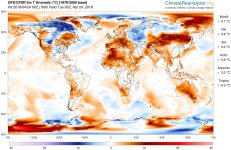
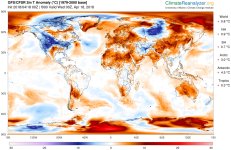
But look at this (read numbers on the right)

00-2.jpg
 
Do rising temperatures have a real impact on the planet and the ocean ?

https://www.nature.com/articles/d41586-018-04660-w

A potential future headache for islands in the caribbean relying on diving for tourism.
It probably also explains the death of the coral in many locations around St Barth

Also in "Nature", we learn that ocean plastic pollution within the GPGP (Great Pacific Garbage Patch) is increasing exponentially and at a faster rate than in surrounding waters.Global annual plastic consumption has now reached over 320 million tonnes with more plastic produced in the last decade than ever before
 
March 2018 was the planet's fifth warmest March since record keeping began in 1880, said NOAA's National Centers for Environmental Information (NCEI) on Wednesday. NASA rated March 2018 as the sixth warmest March on record, with the only warmer March months being 2016, 2017, 2010, 2002, and 2015. The rankings for March were cooler than we've seen in recent years thanks to the presence of colder weather than average over much of Europe, plus the presence of cool ocean temperatures over the Eastern Pacific from a weak La Niña event.

As expected
Arctic sea ice extent during March 2018 was the second lowest in the 40-year satellite record, behind the record set in March 2017, according to the National Snow and Ice Data Center (NSIDC).

Hopefully some positive news
La Niña conditions remained but weakened over the equatorial Pacific during the past month, said NOAA’s Climate Prediction Center (CPC) in its April 12 monthly advisory. NOAA predicted that the current weak La Niña event that began in August 2017 is near its end, with a 55% chance that it will transition to a neutral state by May (these are the same odds that they gave in their February outlook).

Global ocean temperatures during March 2018 were the fifth warmest on record, and global land temperatures were the seventh warmest on record.
 
A new forecast is out

[FONT=&quot]The 2018 Atlantic hurricane season is expected to feature a nearly average number of hurricanes and tropical storms, according to a seasonal outlook released by The Weather Company, an IBM Business.[/FONT]
[FONT=&quot]The Weather Company expects 13 named storms throughout the season, including six hurricanes and two major hurricanes of Category 3 or greater intensity.

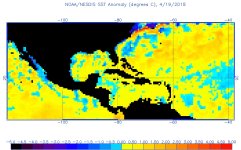
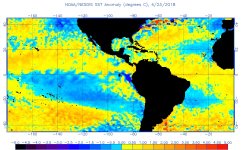
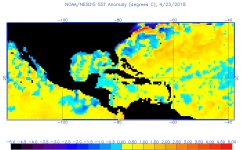
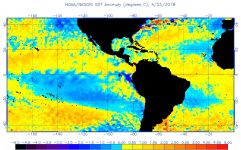
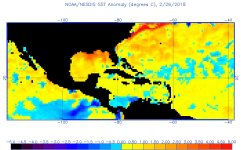
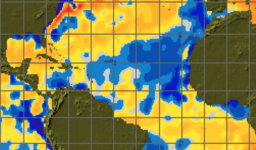
As some were wondering why those maps ...here's the answer

[/FONT]

[FONT=&quot]A pattern of cooler-than-average water temperatures has developed in the eastern Atlantic and, to a lesser extent, in the central northern Atlantic. [/FONT]
[FONT=&quot]The Weather Company compared anomalies in April for inactive vs. active hurricane seasons and found that the current pattern more closely represents inactive hurricane seasons.
[/FONT]

[FONT=&quot]Keep in mind, it isn't anomalous water temperatures that create or hinder tropical cyclone development, but rather actual temperatures that affect tropical storms and hurricanes.[/FONT]
[FONT=&quot]Temperatures in the space between the Lesser Antilles and Africa are supportive for tropical growth nearly year-round, but the warmer the water in that region, the more likely a tropical cyclone is to develop there, all other factors (wind shear, atmospheric moisture, forward speed, etc.) held constant.[/FONT]
[FONT=&quot]Should this pattern of cooler-than-average ocean temperatures continue into the heart of hurricane season (August, September and October), we can expect less tropical activity west of Africa.[/FONT]
 
More fascinating predictions are forecasts ...one for 2022.

And a short resume

  • Averaged over the five-year period 2018-2022, forecast patterns suggest enhanced warming over land, and at high northern latitudes. There is some indication of continued cool conditions in the Pacific sector of the Southern Ocean and enhanced warming in the Atlantic sector of the Southern Ocean. Current relatively cool conditions in the North Atlantic sub-polar gyre are predicted to return to more normal conditions with potentially important climate impacts over Europe, America and Africa.
  • During the five-year period 2018-2022, global average temperature is expected to remain high and is very likely to be between 0.96°C and 1.54°C above the pre-industrial average period from 1850-1900. This compares with an anomaly of +1.14 ± 0.1 °C observed in 2016, currently the warmest year on record. There is a small (~10%) chance of one year temporarily exceeding 1.5°C.

https://www.wunderground.com/cat6/looking-warm-forecast-heres-one-2022

TA-DA
 
Should the island increase investments,preparations for future hurricanes ?

https://www.wunderground.com/cat6/will-global-warming-create-larger-hurricanes

Computer modeling work consistently indicates that greenhouse warming will increase the average intensity of global tropical cyclones by 2 - 11% by 2100, with an increase in the number of Category 4 and 5 storms (though the majority of the models predict that the number of weaker tropical cyclones will decrease). Global warming is also expected to make tropical cyclones rainier, with up to 20% more precipitation falling within 100 km of the storm center

Imagine Maria with 20% more rain.
1.2 trillions gallons of water instead of a trillion....mind blowing
 
Status
Not open for further replies.
Top