January 2018 was the planet's fifth warmest January since record keeping began in 1880, said NOAA's National Centers for Environmental Information (NCEI) on Tuesday. NASA also rated January 2018 as the fifth warmest January on record, with the only warmer Januarys being 2016, 2017, 2007 and 2015. Global ocean temperatures during January 2018 were the fifth warmest on record, and global land temperatures were the eighth warmest on record.


You are using an out of date browser. It may not display this or other websites correctly.
You should upgrade or use an alternative browser.
You should upgrade or use an alternative browser.
Intriguing weather in 2018
- Thread starter chris83
- Start date
- Status
- Not open for further replies.
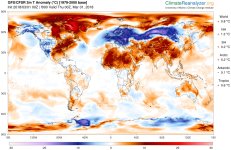
Arctic sea ice extent during January 2018 was the lowest in the 39-year satellite record, beating the record set in January 2017, according to the National Snow and Ice Data Center (NSIDC). Near-surface air temperatures (about 2,500 feet above sea level) were unusually high over the Arctic Ocean in January, with nearly all of the region 3 degrees Celsius (5 degrees Fahrenheit) or more above average.
Very important for St Barth
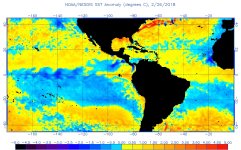
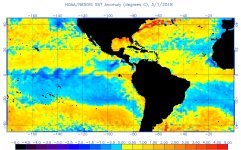
La Niña conditions remained over the equatorial Pacific during the past month, said NOAA’s Climate Prediction Center (CPC) in its February 8 monthly advisory. They predicted that the current weak La Niña event that began in August 2017 is near its end, with a 55% chance that it will transition to a neutral state during the March – May timeframe. Over the last few weeks, though, sea surface temperatures (SSTs) in the benchmark Niño 3.4 region (in the equatorial Pacific) have remained well below the 0.5°C-below-average benchmark that is required to qualify as a weak La Niña.
La Niña conditions remained over the equatorial Pacific during the past month, said NOAA’s Climate Prediction Center (CPC) in its February 8 monthly advisory. They predicted that the current weak La Niña event that began in August 2017 is near its end, with a 55% chance that it will transition to a neutral state during the March – May timeframe. Over the last few weeks, though, sea surface temperatures (SSTs) in the benchmark Niño 3.4 region (in the equatorial Pacific) have remained well below the 0.5°C-below-average benchmark that is required to qualify as a weak La Niña.
Another incredible event
Astonishing summer-like heat cooked the Eastern U.S. on Wednesday, smashing all-time records for February warmth in cities in at least ten states, from Georgia to Maine. At least 24 cities recorded their hottest February temperature on record on Wednesday, including New York City (78°), Hartford, CT (74°) and Concord, NH (74°). According to Weather Underground weather historian Christopher C. Burt, February 20 - 21 marked the most extraordinary heat event to ever affect the Northeastern quadrant of the U.S. during the month of February, since official records began in the late 1800s.
Pittsburgh, PA: 78°F (old record 77°F on Feb. 8, 1900; POR back to 1875)
Indianapolis, IN: 77°F (old record 76°F on Feb. 25, 2000; POR back to 1871)
Charleston, WV: 81°F (old record 80°F on Feb. 24, 2017 & previous; POR back to 1892)
Cincinnati CVG Airport: 79°F (old record 76°F on Feb. 10, 1932; POR back to 1872)
Astonishing summer-like heat cooked the Eastern U.S. on Wednesday, smashing all-time records for February warmth in cities in at least ten states, from Georgia to Maine. At least 24 cities recorded their hottest February temperature on record on Wednesday, including New York City (78°), Hartford, CT (74°) and Concord, NH (74°). According to Weather Underground weather historian Christopher C. Burt, February 20 - 21 marked the most extraordinary heat event to ever affect the Northeastern quadrant of the U.S. during the month of February, since official records began in the late 1800s.
Pittsburgh, PA: 78°F (old record 77°F on Feb. 8, 1900; POR back to 1875)
Indianapolis, IN: 77°F (old record 76°F on Feb. 25, 2000; POR back to 1871)
Charleston, WV: 81°F (old record 80°F on Feb. 24, 2017 & previous; POR back to 1892)
Cincinnati CVG Airport: 79°F (old record 76°F on Feb. 10, 1932; POR back to 1872)

pascaleschmidt
Senior Insider
It was way too hot in NY !!!!
It was way too hot in NY !!!!
And the Arctic is roasting. But in the next week, a highly anomalous, very strong block over Greenland is about to set up. It is the kind of pattern that can send cold into Europe and is conducive to major, slow-moving snowstorms along the East Coast. Just saying...
And the Arctic is roasting. But in the next week, a highly anomalous, very strong block over Greenland is about to set up. It is the kind of pattern that can send cold into Europe and is conducive to major, slow-moving snowstorms along the East Coast. Just saying...
It is sadly consistent with an arctic pole diminishing .A long and cold winter in Europe....Exactly what we are experiencing in the north of Europe.
Will it impact underwater currents and prevent tropical waters to head north (as predicted by scientists) ? that would be major bad news going forward.
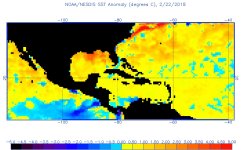
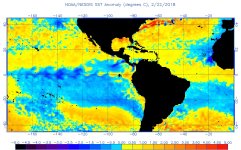
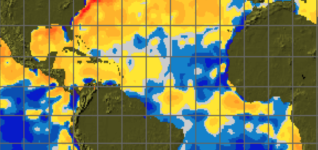
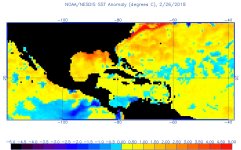
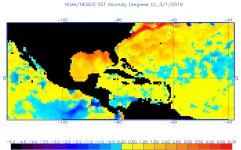
It's quite intriguing to watch the SST anomalies on the US east coast.
Too early to keep an eye on the TCHP,anyway
It is sadly consistent with an arctic pole diminishing .A long and cold winter in Europe....Exactly what we are experiencing in the north of Europe.
Will it impact underwater currents and prevent tropical waters to head north (as predicted by scientists) ? that would be major bad news going forward.
It's quite intriguing to watch the SST anomalies on the US east coast.
Too early to keep an eye on the TCHP,anyway
The past 5-6 winters have followed a remarkably consistent pattern in the Northeast US, regardless of the ENSO (El Nino/La Nina) configuration: Warm falls & early winters into January (this year was one notable exception - we got off to a colder start and had a frigid early January) with long, cold late winters and spring. All of it with more frequent large storms that benefit from the combination of warm Atlantic SST and displaced arctic lobes (the dreaded "polar vortex" the media likes to hype).
pascaleschmidt
Senior Insider
we are used to snowstorms in april... no big deal.
it seems jet streams now play a major role in northern US weather if I understood correctly
Seems there is a link with melting arctic ice sea ice.
I mainly follow Caribbean weather .The area has great prospects,but climate could derail everything
Clearly,lots of stuff going on.
Seems there is a link with melting arctic ice sea ice.
I mainly follow Caribbean weather .The area has great prospects,but climate could derail everything
Clearly,lots of stuff going on.
we are used to snowstorms in april... no big deal.
There s an interesting article on rising sea levels ..and they mention NY
pascaleschmidt
Senior Insider
would not take much to sink most of manhattan and seashores in the area.....
A totally incredible event
https://www.theguardian.com/environ...scientists-alarmed-by-crazy-temperature-rises
https://www.theguardian.com/environ...scientists-alarmed-by-crazy-temperature-rises
How busy is the atlantic this winter ?
"This set up the hurricane force winds on the western side of the storm that are best aimed at the Caribbean and South America. Satellites haven't made a good pass through the storm, somehow, but seas are analyzed to be near 50ft."
And more to come,apparently
http://www.surfline.com/surf-news/s...-ahead-active-atlantic-lining-up-larg_152007/
"This set up the hurricane force winds on the western side of the storm that are best aimed at the Caribbean and South America. Satellites haven't made a good pass through the storm, somehow, but seas are analyzed to be near 50ft."
And more to come,apparently
http://www.surfline.com/surf-news/s...-ahead-active-atlantic-lining-up-larg_152007/
[FONT="]E[/FONT][FONT="]ngland's first ever red "danger to life" alert for snow and ice has been issued by the Met Office, as people are warned to avoid all but essential travel on another day of sub-zero temperatures and "blizzard-like" conditions.[/FONT][FONT="]The highest possible extreme warning is for parts of the south west of England and south Wales. It urges residents to "take action now to keep yourself and others safe" as Storm Emma, rolling in from the Atlantic, looks poised to collide with the "Beast from the East" weather front.[/FONT]
[FONT="]As another day of severe weather left hundreds of drivers stranded overnight and more roads impassable in up to a foot of snow in Scotland and the north of England, further widespread accumulations are expected to bring up to 40cm (15in) in some areas.[/FONT]
[FONT="]As another day of severe weather left hundreds of drivers stranded overnight and more roads impassable in up to a foot of snow in Scotland and the north of England, further widespread accumulations are expected to bring up to 40cm (15in) in some areas.[/FONT]

- Status
- Not open for further replies.


