

You are using an out of date browser. It may not display this or other websites correctly.
You should upgrade or use an alternative browser.
You should upgrade or use an alternative browser.
Intriguing weather in 2018
- Thread starter chris83
- Start date
- Status
- Not open for further replies.

stbartshopper
Senior Insider
Tell that Gargoyle? to stop flapping it's wings- it is cold enough already!

elgreaux
Senior Insider
Hello Dennis
Sadly,it is very difficult to find flights and tourists are flocking to Barbados and Mexico instead.(no surprise,to be honest ).Or skiing.
This season is dead in the water.Numbers are going to be down 80%,or so.
Summer 2018 not looking friendly,neither,according to reports i saw.
what happened to your hope and optimism :thinking1:
Météo France has issued an orange violent wind alert for the Alpes-Maritimes and the Var departments, as well as for Corsica, with gusts of over 200kph expected.
Winds were recorded at cap Corse near 225 km/h...an all time high for Corsica. (last record was in 1993 with 216 km/h)
225 Km/h would mean a cat 4 hurricane,in terms of intensity.
Concerning SBH,as expected,a weak but distinct La Niña continues to hold sway across the tropical Pacific Ocean,with an impact on the caribbean weather expected end of february.
Winds were recorded at cap Corse near 225 km/h...an all time high for Corsica. (last record was in 1993 with 216 km/h)
225 Km/h would mean a cat 4 hurricane,in terms of intensity.
Concerning SBH,as expected,a weak but distinct La Niña continues to hold sway across the tropical Pacific Ocean,with an impact on the caribbean weather expected end of february.
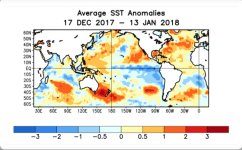
More spectacular weather across Europe.
http://edition.cnn.com/2018/01/19/europe/europe-weather-intl/index.html
More interesting stuff in case you are interested by weather trends (this is not a debate about warming...just facts)
In 2017, Earth experienced its third warmest surface temperature in records going back to 1880—and its warmest year on record without an El Niño event—according to NOAA.
the Japan Meteorological Agency also found that 2017 was the third warmest year in this 137-year period.
NASA data published at midday Thursday ranked 2017 as the second warmest year on record, behind 2016 but just ahead of 2015
Last but not least
Arctic sea ice extent during December 2017 was the second lowest in the 38-year satellite record
2 lovely charts to end the post (courtesy NOAA)
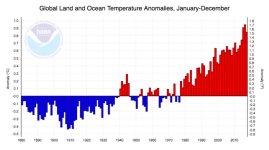
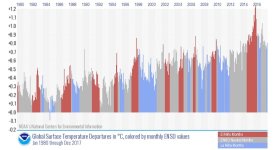
http://edition.cnn.com/2018/01/19/europe/europe-weather-intl/index.html
More interesting stuff in case you are interested by weather trends (this is not a debate about warming...just facts)
In 2017, Earth experienced its third warmest surface temperature in records going back to 1880—and its warmest year on record without an El Niño event—according to NOAA.
the Japan Meteorological Agency also found that 2017 was the third warmest year in this 137-year period.
NASA data published at midday Thursday ranked 2017 as the second warmest year on record, behind 2016 but just ahead of 2015
Last but not least
Arctic sea ice extent during December 2017 was the second lowest in the 38-year satellite record
2 lovely charts to end the post (courtesy NOAA)
Europe is now experiencing some strange weather
https://www.wunderground.com/cat6/floods-record-warmth-high-winds-its-winter-2018-european-edition
For those interested in oceans warming ...here' s a interesting video
https://youtu.be/75pSECm0eqo
https://www.wunderground.com/cat6/floods-record-warmth-high-winds-its-winter-2018-european-edition
For those interested in oceans warming ...here' s a interesting video
https://youtu.be/75pSECm0eqo
Some reporting about St Barth and irma
https://www.wunderground.com/cat6/199-mph-wind-gust-irma-personal-weather-station-record
https://www.wunderground.com/cat6/199-mph-wind-gust-irma-personal-weather-station-record
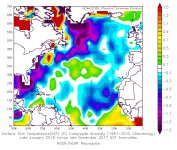
More intriguing data and forecasts keep coming .The UK met office,this time.
https://www.metoffice.gov.uk/news/releases/2018/decadal-forecast-2018
https://www.metoffice.gov.uk/news/releases/2018/decadal-forecast-2018
California is wrapping up one of its driest October-to-January periods on record, and there’s little hope of moisture through at least mid-February.
California Department of Water Resources carried out its monthly high-profile check on snowpack at the benchmark Phillips Station in the central Sierra Nevada. The survey found snowpack at just 14 percent of the historical average, or just 13.6”.
The five weather stations that make up the Central Sierra precipitation index ended January at their third-driest wet season on record.
Unusually warm conditions across the West are making things worse by hastening snowmelt and evaporation. Record highs were set three days in a row this week (Sunday through Tuesday, Jan. 28-30) at the University of California, Los Angeles, where records go back to 1933.
[h=2]La Niña winters (such as the one we’re in now) tend to produce wetter-than-usual conditions across the Northwest U.S., with increasing odds of dryness as you head south. This year, the classic La Niña moisture pattern is roughly holding, except that very strong upper-level ridging across the North Pacific into western North America has shunted moisture further north than usual across the U.S. West—[/h]
"La Niña" is the event to watch this winter.No doubt about that.
California Department of Water Resources carried out its monthly high-profile check on snowpack at the benchmark Phillips Station in the central Sierra Nevada. The survey found snowpack at just 14 percent of the historical average, or just 13.6”.
The five weather stations that make up the Central Sierra precipitation index ended January at their third-driest wet season on record.
Unusually warm conditions across the West are making things worse by hastening snowmelt and evaporation. Record highs were set three days in a row this week (Sunday through Tuesday, Jan. 28-30) at the University of California, Los Angeles, where records go back to 1933.
[h=2]La Niña winters (such as the one we’re in now) tend to produce wetter-than-usual conditions across the Northwest U.S., with increasing odds of dryness as you head south. This year, the classic La Niña moisture pattern is roughly holding, except that very strong upper-level ridging across the North Pacific into western North America has shunted moisture further north than usual across the U.S. West—[/h]
"La Niña" is the event to watch this winter.No doubt about that.
stbartshopper
Senior Insider
After all of this talk on weather, as long as there are breezes, sunshine, some rain to keep things green and those super moons on the island- we are content!
After all of this talk on weather, as long as there are breezes, sunshine, some rain to keep things green and those super moons on the island- we are content!
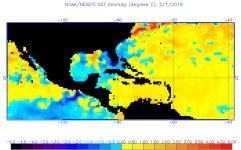
very true..well said.This map should make tourists (and swimmers) happy
But you should keep in mind that many on the island (not the tourists,of course) are watching this data,and very carefully.
A massive pulse of the Madden-Julian Oscillation (MJO) is currently over the Western Pacific. It’s the largest such event in 40 years of recordkeeping for the western Pacific, according to NOAA. As this MJO pulse moves east through the Pacific, it may help drive a chain reaction of events, including severe cold over parts of eastern Canada, very mild air sweeping toward the North Pole, an unusually strong surface cyclone across the Arctic, and a split in the stratospheric polar vortex by mid-February. Computer models have been struggling more than usual in their longer-range forecasts for North America during recent days. In short, we can expect some big weather events over the next several weeks, but where and when they’ll unfold remains uncertain. “Perhaps this enormous tropical signal [the MJO] explains the angst-inducing and soul-crushing volatility of recent model runs,”
A recent study published in Nature outlines research by a team of Yale University and University of Southhampton scientists. The team found evidence that Arctic ice loss is potentially negatively impacting the planet's largest ocean circulation system. While scientists do have some analogs as to how this may impact the world, we will be largely in uncharted territory.
AMOC is one of the largest current systems in the Atlantic Ocean and the world. Generally speaking, it transports warm and salty water northward from the tropics to South and East of Greenland. This warm water cools to ambient water temperature then sinks as it is saltier and thus denser than the relatively more fresh surrounding water. The dense mass of water sinks to the base of the North Atlantic Ocean and is pushed south along the abyss of the Atlantic Ocean.
This process whereby water is transported into the Northern Atlantic Ocean acts to distribute ocean water globally. What's more important, and the basis for concern of many scientists is this mechanism is one of the most efficient ways Earth transports heat from the tropics to the northern latitudes. The warm water transported from the tropics to the North Atlantic releases heat to the atmosphere, playing a key role in warming of western Europe. You likely have heard of one of the more popular components of the AMOC, the Gulf Stream which brings warm tropical water to the western coasts of Europe.
Evidence is growing that the comparatively cold zone within the Northern Atlantic could be due to a slowdown of this global ocean water circulation. Hence, a slowdown in the planet's ability to transfer heat from the tropics to the northern latitudes. The cold zone could be due to melting of ice in the Arctic and Greenland. This would cause a cold fresh water cap over the North Atlantic, inhibiting sinking of salty tropical waters. This would in effect slow down the global circulation and hinder the transport of warm tropical waters north.
AMOC is one of the largest current systems in the Atlantic Ocean and the world. Generally speaking, it transports warm and salty water northward from the tropics to South and East of Greenland. This warm water cools to ambient water temperature then sinks as it is saltier and thus denser than the relatively more fresh surrounding water. The dense mass of water sinks to the base of the North Atlantic Ocean and is pushed south along the abyss of the Atlantic Ocean.
This process whereby water is transported into the Northern Atlantic Ocean acts to distribute ocean water globally. What's more important, and the basis for concern of many scientists is this mechanism is one of the most efficient ways Earth transports heat from the tropics to the northern latitudes. The warm water transported from the tropics to the North Atlantic releases heat to the atmosphere, playing a key role in warming of western Europe. You likely have heard of one of the more popular components of the AMOC, the Gulf Stream which brings warm tropical water to the western coasts of Europe.
Evidence is growing that the comparatively cold zone within the Northern Atlantic could be due to a slowdown of this global ocean water circulation. Hence, a slowdown in the planet's ability to transfer heat from the tropics to the northern latitudes. The cold zone could be due to melting of ice in the Arctic and Greenland. This would cause a cold fresh water cap over the North Atlantic, inhibiting sinking of salty tropical waters. This would in effect slow down the global circulation and hinder the transport of warm tropical waters north.
Another very interesting article about the north pole
https://www.wunderground.com/cat6/models-coming-agreement-widespread-effects-arctic-sea-ice-loss
In relation with the last post (This would cause a cold fresh water cap over the North Atlantic, inhibiting sinking of salty tropical waters. This would in effect slow down the global circulation and hinder the transport of warm tropical waters north.)
https://www.wunderground.com/cat6/models-coming-agreement-widespread-effects-arctic-sea-ice-loss
In relation with the last post (This would cause a cold fresh water cap over the North Atlantic, inhibiting sinking of salty tropical waters. This would in effect slow down the global circulation and hinder the transport of warm tropical waters north.)
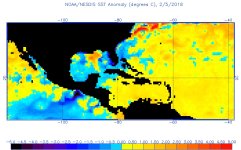
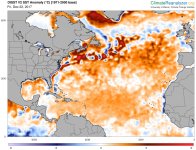
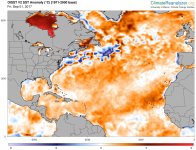
Found this very interesting website http://cci-reanalyzer.org
It has lots of maps and data,and made it easy to compare with the 1970-2000 period
Here is the map end of december 2017
It has lots of maps and data,and made it easy to compare with the 1970-2000 period
Here is the map end of december 2017
- Status
- Not open for further replies.


