

-
This is an archive of older St Barts forum topics and posts.
Information in this sub-forum may be out of date.
If you are researching schedules or time sensitive materials, go to the main forum and ask other members for confirmation.
You are using an out of date browser. It may not display this or other websites correctly.
You should upgrade or use an alternative browser.
You should upgrade or use an alternative browser.
Le Trésor des Sargasses
- Thread starter cassidain
- Start date


cassidain
Senior Insider
Sargasso Sea
From Wikipedia

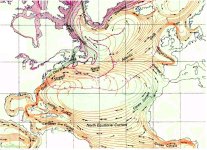
The Sargasso Sea in the North Atlantic is bounded by the Gulf Stream on the west, the North Atlantic Current on the north, the Canary Current on the east, and the North Equatorial Current on the south.
The Sargasso Sea is a region in the gyre in the middle of the North Atlantic Ocean. It is bounded on the west by the Gulf Stream; on the north, by the North Atlantic Current; on the east, by the Canary Current; and on the south, by the North Atlantic Equatorial Current. This system of ocean currents forms the North Atlantic Gyre. All the currents deposit the marine plants and refuse they carry into this sea.
The Sargasso Sea is 700 statute miles wide and 2,000 statute miles long (1,100 km wide and 3,200 km long). It stretches from roughly 70 degrees west to 40 degrees west, and from 20 degrees north to 35 degrees north. Bermuda is near the western fringes of the sea. The Sargasso Sea is the only "sea" without shores.[1] The ocean water in the Sargasso Sea is distinctive for its deep blue color and exceptional clarity, with underwater visibility of up to 200 feet (61 m).[2]
History
Portuguese sailors were among the first to discover this region in the 15th century, naming it after the Sargassum seaweed growing there (sargaço / sargasso in Portuguese).[3] However, the sea may have been known to earlier mariners, as a poem by the late 4th century AD author, Rufus Festus Avienus, describes a portion of the Atlantic as being covered with seaweed, citing a now-lost account by the 5th-century BC Carthaginian explorer Himilco the Navigator. Christopher Columbus and his men also noted the Saragasso Sea, and brought reports of the masses of seaweed on the surface.[4]
Ecology
The Sargasso Sea is home to seaweed of the genus Sargassum, which floats en masse on the surface there. The sargassum is not a threat to shipping, and historic incidents of sailing ships being trapped there are due to the often calm winds of the horse latitudes.[5]
The Sargasso Sea also plays a major role in the migration of the European eel and the American eel. The larvae of both species hatch there and go to Europe or the East Coast of North America. Later in life, they try to return to the Sargasso Sea to lay eggs. It is also believed that after hatching, young Loggerhead Sea Turtles use currents, such as the Gulf Stream to travel to the Sargasso Sea, where they use the Sargassum as cover from predation until they are mature.[6]
The Sargasso Sea was the subject of a recent metagenomics effort called the Global Ocean Sampling (GOS) survey by J. Craig Venter and others, to evaluate the diversity of microbial life there. The results have indicated that, contrary to previous theories, the area has a wide variety of prokaryotic life.[citation needed]
Owing to surface currents, the Sargasso accumulates a high concentration of non-biodegradable plastic waste.[7] The huge North Atlantic Garbage Patch in the area is similar to another ocean phenomenon, the Great Pacific Garbage Patch.
From Wikipedia
The Sargasso Sea in the North Atlantic is bounded by the Gulf Stream on the west, the North Atlantic Current on the north, the Canary Current on the east, and the North Equatorial Current on the south.
The Sargasso Sea is a region in the gyre in the middle of the North Atlantic Ocean. It is bounded on the west by the Gulf Stream; on the north, by the North Atlantic Current; on the east, by the Canary Current; and on the south, by the North Atlantic Equatorial Current. This system of ocean currents forms the North Atlantic Gyre. All the currents deposit the marine plants and refuse they carry into this sea.
The Sargasso Sea is 700 statute miles wide and 2,000 statute miles long (1,100 km wide and 3,200 km long). It stretches from roughly 70 degrees west to 40 degrees west, and from 20 degrees north to 35 degrees north. Bermuda is near the western fringes of the sea. The Sargasso Sea is the only "sea" without shores.[1] The ocean water in the Sargasso Sea is distinctive for its deep blue color and exceptional clarity, with underwater visibility of up to 200 feet (61 m).[2]
History
Portuguese sailors were among the first to discover this region in the 15th century, naming it after the Sargassum seaweed growing there (sargaço / sargasso in Portuguese).[3] However, the sea may have been known to earlier mariners, as a poem by the late 4th century AD author, Rufus Festus Avienus, describes a portion of the Atlantic as being covered with seaweed, citing a now-lost account by the 5th-century BC Carthaginian explorer Himilco the Navigator. Christopher Columbus and his men also noted the Saragasso Sea, and brought reports of the masses of seaweed on the surface.[4]
Ecology
The Sargasso Sea is home to seaweed of the genus Sargassum, which floats en masse on the surface there. The sargassum is not a threat to shipping, and historic incidents of sailing ships being trapped there are due to the often calm winds of the horse latitudes.[5]
The Sargasso Sea also plays a major role in the migration of the European eel and the American eel. The larvae of both species hatch there and go to Europe or the East Coast of North America. Later in life, they try to return to the Sargasso Sea to lay eggs. It is also believed that after hatching, young Loggerhead Sea Turtles use currents, such as the Gulf Stream to travel to the Sargasso Sea, where they use the Sargassum as cover from predation until they are mature.[6]
The Sargasso Sea was the subject of a recent metagenomics effort called the Global Ocean Sampling (GOS) survey by J. Craig Venter and others, to evaluate the diversity of microbial life there. The results have indicated that, contrary to previous theories, the area has a wide variety of prokaryotic life.[citation needed]
Owing to surface currents, the Sargasso accumulates a high concentration of non-biodegradable plastic waste.[7] The huge North Atlantic Garbage Patch in the area is similar to another ocean phenomenon, the Great Pacific Garbage Patch.
Attachments


DaddyLeCool
SBH Insider
Miam ! Also known in southwestern France as "piballes" , it is in addtion quite appreciated in Japan. My grandfather was fishing them in the river Dordogne. As far as I am concerned I have eaten piballes/civelles twice in my life, but I admit it can be seen as worms.


