Cisterns on SBH

stbartshopper

Senior Insider
The Villa we stay in has a cistern and there are little signs in each bathroom that say 'Please conserve water.' We understand the island has a desalinization plant and have never heard of a water issue, at least over the past 10 years.
Has water supply ever been a problem on the island? Could it be? There always seems to be plenty of rain but that may be because we are only there in Feb. and sometimes Mar. Also we are told to only drink bottled water and wonder if people drink from the tap? We see that restaurants only serve bottled water to their clients and hotels stock bottled water in their rooms.
Do most or all Villas, hotels and other establishments operate with large cisterns or is there a water system throughout much of the island or at least maybe in Gustavia and its outskirts?
One thing for certain- there never seems to be an alcohol shortage on the island.:tongue:
 
There is a water system throughout the island that has it's share of breaks from time-to-time. It also is shut down in times of oil spills (recent) and/or strong swells from the north (a year or so ago). I would say that most of us (3 out of 3 moderators) drink only bottled water. Those living on the island may have become accustomed to the flora and fauna that lives in those underground tanks, but most of us are suspect of gutters that indiscriminately collect dove droppings and rainwater.
 
There is a big cost difference between cistern water, and the very expensive "city" water. Most villas, if available, will operate exclusively on cistern water. When and if necessary, they will switch over to city water, or call for the water truck to do an expensive fillup of the cistern.

My practice is to only drink bottled water. While I have every confidence that the cisterns at the villas I rent are properly maintained, it's my vacation, it's short enough as it is, and I take few chances. I drink bottled water, I brush with bottled water, and I trust in the sterilizing power of alcohol to decontaminate the ice in restaurant cocktails.

Yes, in times of limited rain, water can be an issue for the cisterns. In other times the desalinization plant may be shut down, either due to sea conditions potentially clogging the intakes (a few times a year), or the occasional spill in the port, as happened early this year. When the desal plant is down then the island is served by the reserves in the various municipal cisterns until they run dry, at which point if you don't have a supply in your villa cistern then you have no water.

We should all be practicing water conservation on the island. The supply is limited and the city water is very expensive compared to what we pay at home.
 
Ellen would obviously know more about this. However, there has certainly been a water problem on the island in the past. I recall some years ago (we have been visiting the island every year in the Jan-Feb timeframe since the 80's) the water trucks were all over the island refilling the cisterns. The cistern where we were staying in Pt. Milou had to be refilled a couple of times during one of our stays. The desalinization plant has helped a lot but it is still a good idea to conserve water. We drink bottled water but use water from the tap to brush teeth, etc. since the villa where we stay has a filter.
 
On a island with no source of fresh water except desalination of the sea, yes you should always conserve water as much as possible... we drink bottled water although I do cook and brush my teeth with cistern or city water. Desalination was a necessary option to try and produce the huge amounts of water required for hotels, villas, yachts, etc... but it ultimately is not good for the ocean/environment... in the old days, the folks on the island made do with what rain water they could collect in large earthenware jars or small cisterns next to their homes, then the larger cisterns were built under new homes. We have 75 cubic meters of cistern but when there is not enough rain, you do have to buy city water... so please do your best to conserve when you can !
 
Concurring with the water conservation admonitions in above messages, I will add that I remember the days -- as some others here will, as well -- when cisterns were the sole source of water. In order to shower, we would use enough water to get wet . . . then turn it off while shampooing and washing . . . using water again only to rinse. It wasn't a problem, and no one could have imagined anything different.

With respect to "city water," one point that hasn't been mentioned is that availability of water from the desalinization plant can be related to proximity to / distance from the plant. Thus, there have been occasions when there was insufficient water to reach Marigot and points East.

Personally, I use cistern water in the normal course of life on SBH and never have had any problems associated with doing so. I understand the concern of others, however. At the Villa, we switch, as Kevin described, between cistern and city water . . . taps inside the Villa getting more city water as we make an effort to only use cistern water in the garden (city water is quite expensive and, thus, a bit of extravagance for watering plants). At the Hotel, we're required by local law to use city water (again, cistern water is used for trees, plants, and washing windows).
 
In many places bottled water is frowned upon since it produces lots of waste and it is very inefficient to transport water by truck rather than pipe. That isn't necessarily the case in SBH but why don't villas have large water coolers with refillable carboys? Doesn't that make more sense than buying six packs of 1L bottles.
 
just wondering, what would you put in the refillable water coolers? most people on the island do not drink cistern or city water... thus the demand for bottled water, and they burn the plastic bottles at the incinerator... only glass and metal get recycled...
 
You would refill the carboys at the marché. Or trucks could come by and replace empty bottles with full. Is burning plastic good for CO2 emissions? Canada isn't the most environmentally friendly place but we no long allow burning of garbage in Toronto.
 
8314688253_fb3f7602d3_z.jpg
I would assume most rental villa owners follow this procedure:

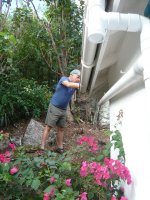
Gutters are checked, kept clean weekly by the gardener (also controls skeeter breeding) and the cistern has a filter which is changed on a regular basis. We also add bleach to the water during those times. The gutters have large screens to prevent sticks and leaves from entering and the "T" fittings are unscrewed to clean as well. Should the cistern become really dirty (ours was when we purchased, from neglect) it's drained and powerwashed on the inside.
We use cistern water to shower, brush teeth and consume bottled water for drinking.
If the cistern water drops to a certain level due to high use or lack of rain we add expensive water from the municipal source (not all areas of the island have this available) via a meter on our property.
 
You would refill the carboys at the marché. Or trucks could come by and replace empty bottles with full. Is burning plastic good for CO2 emissions? Canada isn't the most environmentally friendly place but we no long allow burning of garbage in Toronto.

I have lived in the US, Canada ( QC) and St Barth, and what may seem logical in one place does not necessarily work in another. As far as garbage disposal in Toronto, it seems that there are many options there that are not available in St Barth. Having trucks deliver water...or anything on this island is expensive....and things are expensive enough as it is. Besides, we are not here ( in St. Barth) all of the time, not rented all of the time, sometimes 2 people, sometimes 6...it would be difficult to schedule deliveries of water and then who would pay for it, guests or villa owners? Just a few thoughts....
 
I can't see water coolers. Who would change the bottles? It's so easy to buy a 6 pack of 1.5s when needed.
 
making the simple complicated.....buy 1.5 Liter to 1 gallon sizes.....and waste gets cut signifcantly
 
Has water supply ever been a problem on the island? Could it be? There always seems to be plenty of rain but that may be because we are only there in Feb. and sometimes Mar.

The months you cite, February and March, are actually the two driest months of the year.
 
I'm a little surprised that there's not more awareness of grey water recycling on the island. If your need for fresh water is great enough to install a municipal desalininazation plant, then why wouldn't building codes be changed to mandate grey water systems in new construction and/or renovation?

[h=1]Greywater[/h]From Wikipedia, the free encyclopedia


Greywater or sullage is defined as wastewater generated from wash hand basins, showers and baths, which can be recycled on-site for uses such as WC flushing, landscape irrigation and constructed wetlands. Greywater often includes discharge from laundry, dishwashers and kitchen sinks. It differs from the discharge of WC's which is designated sewage or blackwater to indicate it contains human waste.

Might be a PITA to retrofit existing plumbing...most of the current waste lines would need to be redirected....but for renovation or new construction, not a big deal.

again, if you guys are telling me that water is a precious resource on the island, then why not use every drop as many times as possible???


Top