andynap
Senior Insider
At www.journaldesaintbarth.com .
.. LES SECRETS DES SOS DE SAINT-JEAN & by Pauline Sauthier m 04/02/2021 We found the waste of the former inhabitants of Saint-Barth. A few meters below the ground surface, on the site of a construction site in Saint-Jean, a preventive diagnosis revealed vestiges of the pre-Columbian period. Imagine, around 1700-1500 years before Jesus Christ, a group of people, probably nomads, perhaps in extended families, who heat queen conch on the sandy cordon located between the pond and the beach of Saint-Jean. The group stays for a while (we don't really know how much) on this beach, leaves the remains of their consumption on the spot (burnt conch shells, burgos, charcoal, polished stones) then sets out again, probably towards other Caribbean islands. A few centuries later, around the seventh or eighth century after Jesus Christ, other groups settled down, almost in the same place, tasted shells, turned the shells into tools, perhaps created a village and dumped their waste there. , empty shells. It is because men decide to build a house in this same area in the 21st century that we find the remains of this rubbish. And that we make them tell their story. Archaeological diagnosis When a building permit was requested for a villa in Saint-Jean, the direction of cultural affairs (DAC) of Guadeloupe immediately asked to be able to carry out an archaeological diagnosis beforehand. that the works do not begin, likely to disturb the ground and the vestiges which hide there. "The location of the plot between the coast and the Saint-Jean pond presented a double interest: we know that it is in this kind of geographical context that the Amerindians settled, it is an environment that suits them. to live because of the proximity to the sea and its food resources.
In addition, all over the cordon of Saint-Jean we have already found Amerindian vestiges, ”declares Nathalie Sellier-Segard, in charge of archaeological studies and operations at the National Institute for Preventive Research (INRAP). She was the one who carried out the diagnosis. The operation is quick: only three days. But it shows a very well preserved trace of the passage of men. A further preventive search may be requested before the start of construction work on the villa. “We can expect the site to be quite rich in terms of furnishings. », Explains Nathalie Sellier-Segard. While excavating the land, archaeologists uncover remains from two distinct pre-Columbian eras, the Mesoindian period (c. 4000 to 500 BC) and the Neo-Indian period (c. 500 BC - c. 1500 AD). They know this in particular after having dated certain carbon 14 queen conch shells.
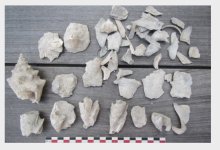
A structured site The oldest shells found on the Mesoindian site come from a period estimated between 1751 and 1314 BC. The remains of burnt queen conch found there are the mark of a method of extracting the shell from a brazier, already observed in Saint-Martin. The INRAP teams also discovered broken shells, which could have been transformed into tools (points, ax or containers) and burgos systematically broken for a reason we do not know. They may have been used to make hooks. The elements collected on the site are still too small to specify the exact use of the polished pebbles found on site. The interest of his excavations is to accumulate more and more knowledge on these populations of hunter-gatherers, by comparing the elements already discovered during this period in Saint-Barthélemy, Saint-Martin or elsewhere in the West Indies. “Each site can have a specificity. Here it can be a habitat site like a fishing stop, ”explains Nathalie Sellier-Segard.
If he has yet to reveal his secrets, Dominique Bonissent, regional curator of Guadeloupe archeology, explains to us that this excavation space is “the most structured Mesoindian site discovered in Saint-Barthélemy. " A village ? In the Neoindian stratigraphic layer, archaeologists discover the remains of pierced queen conch and burgos, a method of cooking characteristic of the Neoindian period. The carbon dating of a queen conch confirms that this shell comes from a period between 636 and 770 AD. These remains, combined with others discovered along the sandy rim, suggest to archaeologists a larger occupation of the site. “A preventive excavation will be able to refine the chronological range,” recalls Nathalie Sellier-Segard. It could make it possible to know if we are in a village or a fishing stop. "